
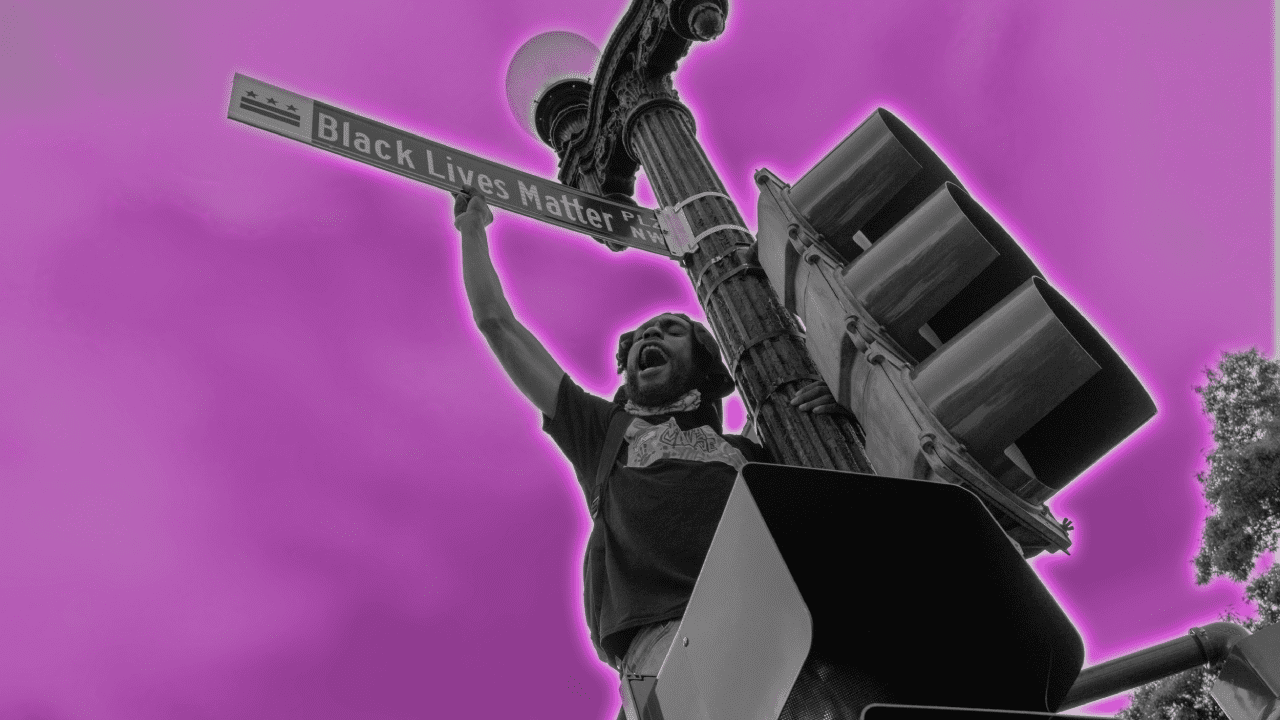
With the idea of identity politics becoming an increasingly popular topic over the past decade, it’s also become sharply divisive.
Some people argue fiercely that it’s giving voice to marginalised people, while others view it as a more destructive force in society.
Which side is right? Here are their key arguments.
The Context
Overview
Identity politics is a broad concept, which describes the political organisation of groups based on identifying characteristics. For example, in the 1960s social justice protest movements in the US demanded political reform for women and Black people, respectively.1
Origins
The term’s origins lie in US political activism and philosophy from the past century or so. The first recorded usage is from 1973, by Todd Gitlin, an American sociologist.2 A defining statement for the term was issued in the 1977 statement by the Combahee River Collective, a Black Feminist group, which stated:
Our politics evolve from a healthy love for ourselves, our sisters and our community which allows us to continue our struggle and work. This focusing upon our own oppression is embodied in the concept of identity politics. We believe that the most profound and potentially most radical politics come directly out of our own identity…3
The concept may have stemmed directly from the idea that “the personal is political”, a term that was coined in an essay authored by Carol Hanisch in 1969, within the radical feminism movement.4
However, it is a broad notion and there are historical precursors which weren’t labelled as such.5 The term has evolved a lot and has different connotations in different contexts.
Purpose
To give a political voice to the concerns of people who would otherwise be underrepresented in wider society. In this sense, it is non-partisan and has been a tactic used by different ends of the political spectrum.
It considers identity as a defining and differentiating political factor — as opposed to, say, belonging to a universal political constituency. For example, your national, ethnic or religious identity.
The Arguments
For
It gives a voice to oppressed peoples
Using identity as a unifying platform gives a much stronger platform for minorities and the oppressed. For example, the Civil Rights movement in the US in the 60s mobilised by speaking to the specific inequality that Black people suffered, rather than by allowing the issue to be absorbed into a broader, more abstract and universal debate.6 People who claim it leads to cancel culture and censorship are simply upset that they’re not the loudest or only voices in the room.7
Identity is a central political idea
Identity holds weight — even if you don’t want to believe in this narrative, it has real world outcomes, as we’ve seen time and again with racialised exploitation of power.8 Identity politics in liberal democracies works because it is strengthens the framework of individual rights by advocating for those who suffer from injustice or oppression. For example, the Women’s Liberation Movement fought against the unequal implementation legal and economic status of women within the existing societal paradigm. Identity is a useful political starting point in societies in which individual rights are undermined along the lines of group identities.
It values people’s lived experience
Dominant groups can fail to see the harm their behaviour elicits — a clear example being the #metoo movement. Identity politics reframes the debate by validating people’s lived experiences as unique to them. Identity politics recognises the differences or inequalities that exist between the experiences of different groups and gives them a platform for entry into political debate. For example, the US policy of Affirmative Action offered a form of restorative justice to Black Americans who had historically been denied opportunity. 9
It’s effective, and has improved people’s lives
Some of the most crucial and progressive political fights have succeeded because of the mindset of identity politics: key examples include the movements for civil rights, women’s equality and gay rights. Zack Beauchamp argues that it has given liberal politics a strong platform for success in the US:
In recent years, we have seen champions of identity politics rack up impressive accomplishments — victories like defeating prosecutors with troubling records on race at the ballot box, getting sexual assault allegations taken seriously in the workplace, and securing health care coverage for transition-related medical care.10
People currently use the term identity politics in a pejorative sense to undermine new ideas that they dislike, in effect scapegoating a perfectly normal political tactic.
It de-marginalises people
Denying the political importance of identity is easy for people who have never faced a significant absence of representation, power or legal status. In the West, for example, Whiteness is taken for granted as the default identity: the majority simply doesn’t recognise that the the standard mode of politics is an identity-based one, because the majority is White and has benefited from its success.11 When other groups engage in identity politics, they’re simply participating in a system as a constituency that would otherwise go ignored the power and voice and would ignore issues that are of crucial importance to their prosperity and rights.
Against
It is used to polarise society
Even if the idea of identity politics stemmed from idealistic aims of promoting underrepresented people, it has become a cynical tactic used by politicians and corporations to advance their narrow aims.12 By segmenting populations into their divergent characteristics, identity politics puts people at odds with each other, rather than build solidarity through broad, inclusive movements.1314 We’ve seen this in the US, in which the term ‘identity’ has become a shorthand for how non-White people feel in relation to a White hegemony against which they’re in conflict.15 The inevitable outcome is smaller, more exclusive, oppositional and atomised sections of society looking at each other with distrust, rather than a more collaborative and inclusive political world view.1617
Identity is complex. Broad definitions are unreliable
Identities are dynamic and susceptible to change — prominent philosophers such as Slavoj Zizek have argued would argue they’re constructs or narratives, rather than hard truths.1819 As a result, a politics built on identity lacks a more universal, codifying structure. People who share, say, an ethnic or racial background aren’t a monolith, but identity politics treats them as such.20 People who disagree with the supposed representatives or majority voices in their identity group can be accused of betrayal, leading to a less tolerant and inclusive outcome21.
It weaponises people’s identities for political ends. It can lead to violence
There are countless instances of people’s ethnic or racial identities being used to foment hatred or fear. A few recent, prominent examples include: the persecution of the Rohingya Muslim minority in Myanmar; the upsurge in antisemitism in the UK and the US in the 21st century; the anti-Bosnian identity politics and genocidal campaign of the Serbs in the 1990s; the 1994 Rwandan genocide.22232425
Lived experience is not a reliable standard
A person’s lived experience as a member of an identity-based group can be used to give themselves authority — for example on the experience of growing up as a racial minority in the UK or the US. However, individual and group identities can change over time. They’re also ‘unmediated and self-interpreting’, which makes them hard to refute.26
Data-led policies, facts, and open debate are more inclusive and less prone to the bias any one person might carry, consciously or not.2728
It’s anti-meritocratic
Codifying people’s ethnic, religious or social characteristics inevitably leads to discrimination. Even if the intentions might be good sometimes, the net effect is that people are selected for jobs or positions of authority based on their identity, rather than their experience, skills and potential.29 Furthermore, the philosophy that we’re defined by, say, our race, sexuality or gender is condescending to those who want to consider themselves independently minded from a group mode of thought.30 It lacks true substance and distracts from the actual issues that affect people.31
Enter the debate
Enter the debate
Add a comment below to share your view.
This article aims to provide a general introduction to a complex debate. Our goal is to create healthier disagreements, in which people consider both sides of an argument.
If you want to submit a revision, please leave a comment below with your proposed edit, including your sources.
External links
Video
- Debate: Identity Politics is Tearing Society Apart, 2020 | Intelligence Squared
- What is left after we accept identity politics as a fiction? | Slavoj Zizek & Yuval Noah Harari, 2023
- Ezra Klein | The Ben Shapiro Show Sunday Special Ep. 86, 2020
- Identity Politics Debate: John McWhorter & Michael Eric Dyson, 2020
- Slavoj Zizek — Black Lives Matter & identity politics, 2020
- Identity Politics: Lionel Shriver & Douglas Murray | The Spectator
Podcasts
- The Dangers of Identity Politics, Tortoise Media, 2024
- Election 2024: Are Identity Politics Holding Us Back? , Open to Debate, 2024
Footnotes
- Kurzwelly, J., Pérez, M. & Spiegel, A.D. Identity politics and social justice. Dialect Anthropol 47, 5–18 (2023) ↩︎
- Oxford English Dictionary, Identity Politics, 2024 ↩︎
- Combahee River Collective, 1982, “A Black Feminist Statement,” 1973 ↩︎
- Hanisch, Carol, The Personal Is Political, 1969 ↩︎
- Heyes, Cressida, “Identity Politics“, The Stanford Encyclopedia of Philosophy (Winter 2024 Edition), Edward N. Zalta & Uri Nodelman (eds.). ↩︎
- ↩︎
- Debate: Identity Politics is Tearing Society Apart ↩︎
- What is left after we accept identity politics as a fiction? | Slavoj Zizek & Yuval Noah Harari, 2023 ↩︎
- Ezra Klein | The Ben Shapiro Show Sunday Special Ep. 86 ↩︎
- Beauchamp, Zack, “Identity politics isn’t hurting liberalism. It’s saving it.“, Vox, 2020 ↩︎
- Identity Politics Debate: John McWhorter & Michael Eric Dyson, 2020 ↩︎
- Elite Capture: Philosopher Olúfẹ́mi O. Táíwò on How the Powerful Took Over Identity Politics ↩︎
- Chesterton, George, “In a world obsessed with identity, we’ve become more divided than ever“, The Daily Telegraph, 2024 ↩︎
- Identity Politics: Lionel Shriver & Douglas Murray | The Spectator ↩︎
- Identity Politics Debate: John McWhorter & Michael Eric Dyson, 2020 ↩︎
- Gitlin, Todd, The Left, Lost in the Politics of Identity, Harper’s, 1993 ↩︎
- Shivani, Anis, Time to give up on identity politics: It’s dragging the progressive agenda down, Salon.com, 2017 ↩︎
- What is left after we accept identity politics as a fiction? | Slavoj Zizek & Yuval Noah Harari ↩︎
- Slavoj Zizek — Black Lives Matter & identity politics ↩︎
- Ager, Freya India, “Are all lived experiences equal?”, Spiked, 2021 ↩︎
- Thomas Sowell on the men who betrayed Martin Luther King ↩︎
- O’Neill, Brendan, “Is identity politics to blame for the rise of anti-Semitism?“, The Spectator, 2023 ↩︎
- Rachman, Gideon, “Anti-Semitism and the threat of identity politics“, The Financial Times, 2018 ↩︎
- Goran Basic & Zlatan Delić (21 Feb 2024): Ideology, war, and genocide –
the empirical case of Bosnia and Herzegovina, Journal of Contemporary Central and Eastern Europe, DOI: 10.1080/25739638.2024.2320474 ↩︎ - Ansari, M. B. Reconfiguring Identity Politics and Social Exclusion: The Case of Rohingya Refugees in Bangladesh. Preprints 2024, 2024100493. ↩︎
- Casey, Patrick J, What is ‘lived experience’?, Aeon, 2024 ↩︎
- Appiah, Kwame Anthony, Why are politicians suddenly talking about their ‘lived experience’?, The Guardian, 2020 ↩︎
- Ezra Klein | The Ben Shapiro Show Sunday Special Ep. 86, 2020 ↩︎
- Ehsan, Rakib, “The obsession with ‘diversity’ is putting Britain in danger“, The Daily Telegraph, 2024 ↩︎
- Identity Politics: Lionel Shriver & Douglas Murray | The Spectator ↩︎
- Slater, Tom, Kamala Harris and the revolt against identity politics, Spiked, 2024 ↩︎



Leave a Reply